Surrender of the High Seas Fleet
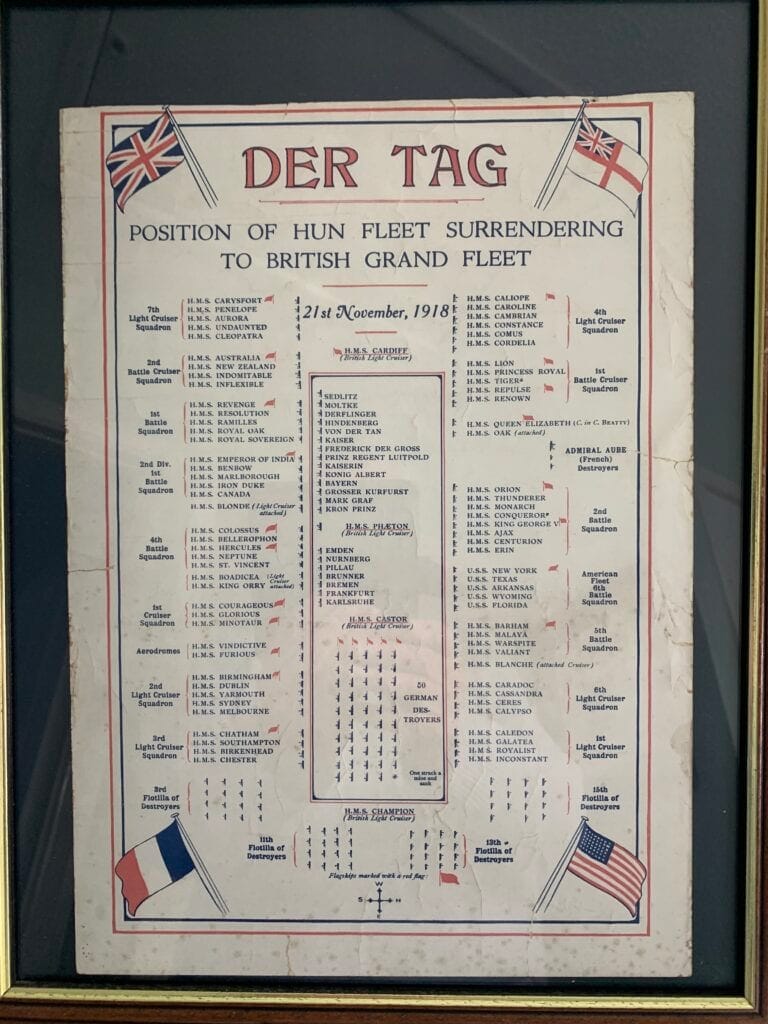
On my wall hangs the Der Tag, poster a reminder of a by-gone age an event never to be repeated. Der Tag is German for “The Day”, the poster lists the ships in this context present on 21 November, 1918 during the surrender of the German High Seas Fleet to the British Grand Fleet and represented allies. It is likely most sailors in the Allied Fleet received one of these posters printed on parchment paper as a memento. One of those sailors present was my Paternal Grandfather, who served with the Royal Navy 13th Destroyer Flotilla during the surrender. The list might still be quite common even today, although I have not seen another.
By August 1918 the German Army on the Western Front was reaching the end of its endurance, but the High Seas Fleet was virtually intact. The Kaisers admirals still plotted to lure the British Grand Fleet into a last great battle, which they hoped would show German resolve to fight on and which, in turn might influence any peace negotiations to their advantage, but they had seriously misjudged the mood on the lower decks
When the High Seas Fleet put to sea on October 29 1918, it was materially stronger than it had been at Jutland in May 1916. However the crews saw no future in this defiant gesture and a mutiny broke out. The officers managed to restore a brittle discipline, but with unrest still simmering, they prudently abandoned the operation.
On November 11, 1918, Germany signed an armistice, ending the Great War. In the agreement, the Allied Naval Council decreed the German Fleet should be confined to port under their supervision.
No neutral country could be found that was willing to play host to them. The Allied Council then came to the decision that the only safe place for such a large force was Scapa Flow, where they could be watched by the Grand Fleet.
Rear Admiral Ludwig von Reuter was requested, rather than ordered, to carry out this unenviable task of leading the High Seas Fleet into internment. He wrote in a report that “…personal feelings had to step to the rear…” for he was still serving his country.
Reuter took command on November 18, the next day the High Seas Fleet of some seventy ships departed ready to meet the Allied escorts on the 21st. The escort, some 90,000 seamen in 370 warships, steamed out of the Firth of Forth in single file to receive the surrender of the German Fleet.
Admiral David Beatty in command of the Grand Fleet described the sight when the fleets met. “We never expected that the last time we should see them as a great force would be when they were being shepherded, like a flock of sheep, by the Grand Fleet. It was a pitiable sight…”
The light cruiser HMS Cardiff went ahead to meet von Reuter’s flagship, the Fredrick der Grosse, and the eight battleships and five battle cruisers that followed in line ahead, followed by sixty smaller ships. One German officer wrote it was “An endless funeral procession over 50 kilometres in length”.
Lieutenant Brian de Courcy-Ireland wrote. “We in HMS Westcott (a new destroyer) went out to meet them halfway, fully manned and ready. We were rather uncertain about what was going to happen, though we understood they had removed their ammunition. Out of the mist on that sunny day it really was quite a sight to see them coming toward us”.
Lieutenant John Ouvry on the cruiser Inconstant wrote. “The excitement was of course intense as it was impossible to tell whether the Hun had something up his sleeve for us or not. It seemed too wonderful for an extremely powerful fleet to give themselves up without a blow”.
A haze descended over the area that morning reducing visibility. “Thus heaven conferred a certain mantle on our shame in the form of a light mist”, wrote von Reuter, “and the most tremendous tragedy ever enacted at sea was thereby softened to the view”.
A lieutenant aboard the US Navy battleship New York described the procession from his point of view. “The tiny light cruiser Cardiff, towing a kite balloon, leads the great German battle cruiser Seydlitz, at the head of her column, between our lines. On they pass Derfflinger, Von Der Tann, Hindenburg, Moltke as if on review. The low sun glances from their shabby sides. Their huge guns, motionless, are trained fore and aft…” The others followed “powerful to look at, dangerous in battle, pitiful in surrender”.
The German ships were escorted to the Firth of Forth, where they were inspected by boarding parties. At sunset, the German ensigns were lowered, and Admiral Beatty ordered that they were not to be raised again. Boy sailor Frank Dandy witnessed it. “I remember it well. We stood lined up on the deck of the Barham when the German Fleet sailed in. We were next in line to the Warspite”. A few days later the German ships were moved to Scapa Flow. My Grandfather, Albert William David Simmons, during the Great War, served aboard the battle cruiser HMS Tiger and the battle ship HMS Conqueror and with the 13th Destroyer Flotilla when the German High Seas Fleet surrendered on November 21 1918. It was him who left behind the “Der Tag” poster.
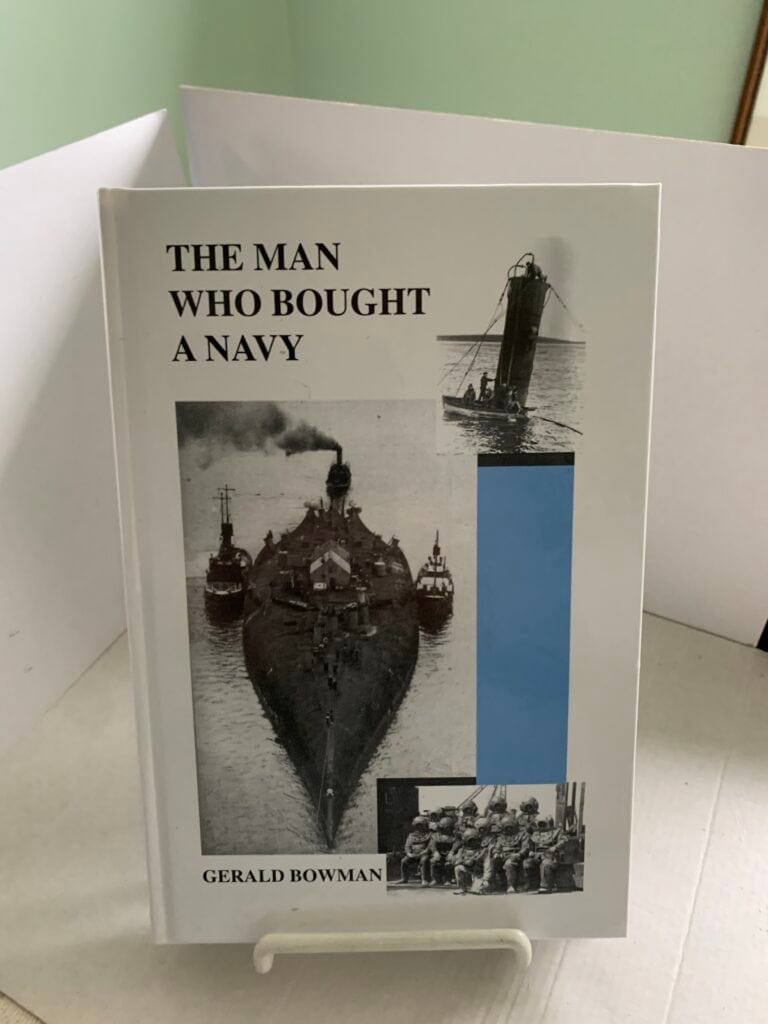
An interesting and rare book is in the shop relating to this ‘The Man who Bought a Navy’ by Gerald Bowman tells the story how many of these ships were salvaged.