From Grand Prix winner-SOE agent
On the evening of Saturday 30 May 1942, a Handley Page Halifax of 138 Squadron took off from RAF Tempsford, near Sandy in Bedfordshire. It would have barely registered amongst all the other blips on the radar stations, or at RAF Bomber Command’s operation room as over 1,000 aircraft were taking to the air that night. Their flight path would take them out over the North Sea, destination the ancient city of Cologne on the River Rhine. While the lone Halifax flew south across the English Channel, on board other than the crew, two ‘Joes’ agents for one of the clandestine operators SIS or SOE. The air crew knew nothing about them, other than they were to drop them near Le Mans. It was to be a blind drop; there would be no help on the ground. The Navigator had to find four small lakes using just his charts and the moonlight, yet find the dropping zone he did. The two ‘Joes’ left through the hole in floor the hatch removed by the radio operator/gunner. First one sat on the edge wearing bulky parachute gear over civilian clothing. His legs dangling into the void of space and being buffeted by the 160 mph slipstream with the green light the first, Charles was away, to be followed rapidly by Sebastian. Two suitcases were thrown after them. Then the static lines that opened the parachutes were retrieved. The aircraft turning to fly over Le Mans the hatch still open, once over the town bundles of propaganda leaflets were shovelled out, in an attempt to cover the real mission.
The two men only knew each other through their code names Charles and Sebastian, the latter had been called ‘Vladimir’ but that was another code-name. Charles was Christopher Burney a former Commando who had seen action in Norway in 1940, he had met his travelling companion only hours before in London, just before getting into a car that took them north. Burney likened his companion to a bank manager who he felt was ‘rather suspicious’ but ‘respectable.’ The man sat beside him was fifteen years older and, when Burney was a schoolboy, had won the first Monaco Grand Prix held on 14 April 1929.
Charles Frederick William Grover, who liked to be called ‘Williams ‘but was affectionately called Willy had bought his car for the race off Ettore Bugatti, it was a Type 35B, the only stipulation the Le Patron made was he should not race in French blue so Willy painted the car green.
Willy and his crew of two were late arriving at the circuit for the 100 lap race and missed the practice, around a circuit that is not much different to that used today. He managed to do a few laps early on the morning of the race. There were other privately-owned Bugattis, Alfa Romeos and Maseratis, and a huge Mercedes SSK for Germany’s star driver Rudi Caracciola. The grid positions were drawn by lots for the sixteen entrants. Willy was lined up in the middle of the second row of three cars. There was a large crowd and when the starting flag dropped Willy made a good start, he was second before they reached the corner by the Church of St. Devote. Willy was in the lead by the end of the first lap. Most of the race

developed into a battle between Caracciola and the Englishman, until a long pit-stop for fuel dropped the German to third.
This was no lucky win for in the five years 1928-1933 Willy won seven Grand Prix including the French GP run at Le Mans in 1929 and the 10 hour Belgian GP of 1931, in the latter he defeated the brilliant Tazio Nuvolari in the Alfa Romeo 8C. Williams was probably the most successful, if not the best known, British racer before WWII.
Williams was born in France in 1903, his father Frederick Grover a horse trainer and breeder worked for Prince Ivan Yurievich Trubetskoy a wealthy Russian aristocrat and diplomat who worked at the Russian Embassy in London. Trubetskoy was obsessed with breeding the perfect horse. When he was transferred to the Embassy in Paris he persuaded Grover to go with him. Frederick settled in Montrouge where he met and married Hermance Dagan, they had four children Willy was the second.
In the early months of WWI Willy was sent to England and stayed with relatives in Hertfordshire, however once the situation had stabilized he returned to France. Not long after this Trubetskoy died and Frederick moved his family away from the Paris area to Monte Carlo. His older sister Lizzie’s boy-friend Richard Whitworth taught Willy how to drive in a Rolls Royce. Willy became a chauffeur, which led him into the world of motor racing. In 1925 with his own car, a Hispano-Suiza, he took part in the Monte Carlo Rally and was one of the 32 finishers. Around this time he became driver to Sir William Orpen the renowned artist. In his employ he first met Yvonne Aubicq, Orpen’s mistress. She was soon smitten with Willy and they married in 1929. They became a real ‘High Society couple, winning several dancing prizes at grand hotels along the Cote d’Azur.’

In 1930 Bugatti signed Willy for his works team. A few months later he had a bad crash at the Tre Fontane circuit near Rome, he was out of action for several months. When he returned to racing he was more subdued, but was probably a better driver for it. At the end of the 1933 season Willy retired from the sport. By that time he had seen many of his contemporary drivers killed. He continued to work for Ettore Bugatti, Le Patron this time selling not racing his cars.
With the coming of the war in 1939 Willy went to the British Embassy in Paris to try and enlist in the British Army. He was told that volunteers could only be accepted in the UK. In February 1940 Willy returned to the Embassy by then the rules had changed and he was enlisted into the Royal Army Service Corps as a driver. He served with the 1st Armoured Division driving staff officers on the roads of Belgium and France he knew so well.
As France was about to collapse he managed to get back to Paris for a conference and managed to see his family. Willy’s brother Frederic recalled the visit at the end of May and that he advised him the battle was lost and ‘to go south.’ Willy left France from Cherbourg on 17 June and he stepped ashore at Falmouth the next day. He was soon in Kent
where the armoured forces were reforming. In letters home he expressed boredom and he was missing Yvonne. By the summer of 1941 he was in Kinross in Scotland in another mundane posting. Yet that autumn Willy received a letter ordering him to London and an interview with the Ministry of Works.
Willy presented himself at the Hotel Victoria, Northumberland Avenue. The Hotel backed onto Scotland Yard. There he was interviewed by a Major. At first he was asked some fairly ordinary questions about his family and background. Eventually languages came up and that his flawless French could be very useful. He was told the likely work they had in mind for him could be dangerous but still Whilly was keen to help. In the following days he was quizzed by other French speakers while MI5 checked his background. Having passed these tests he was sent to Wanborough Manor, SOE’s training school No 5 and had been given his first codename ‘Vladimir.’ His reports described him as an ‘efficient soldier.’ He attended various other training establishments, one in Scotland for Commando training and another in the north of England for parachute training. The finishing school for SOE agents was at Beaulieu Abbey within the New Forrest. There Willy was passed ready for his mission at the end of March 1942, one report said he was ‘surprisingly fit and agile’ which was probably a reference to his age, but noted he could be ‘inclined not to bother.’ Yet he was highly thought of, enough to return to France to build his own network codename ‘Chestnut.’
Back in France Willy was overjoyed to be back with Yvonne but frustrated by lack of progress with ‘Chestnut.’ One reason for this he had no radio operator and coupled to that other groups in particular ‘Prosper’ were given priority. However they did succeed in setting up a sabotage team within the Citroen factory. All French motor manufacturers were forced to work for the Germans. Citroen built about 37,000 cars, military trucks and half-tracks for the Nazi’s. In 1941 the factory produced 14,000 vehicles, by 1943 ‘Chestnut’ had managed to reduce that to 4,500, mainly be disrupting the production line by removing or damaging vital machine parts.
When ‘Chestnut’ finally got a radio operator things began to happen. Five arms drops were delivered by the RAF which was hidden in the country home at Auffargis of Robert Benoist, another former racing driver and close friend, of Willy’s. However the ‘Prosper’ network was betrayed in 1943 and in the fallout ‘Chestnut’s’ radio operator was captured. This led directly to the Benoist’s house where Willy was arrested. Benoist escaped to England and would return to France. Yvonne escaped to the south of France. Willy was subjected to a long interrogation at Gestapo headquarters at Avenue Foch in Paris, which got rough. Ernst Vogt a fluent French speaker questioned Willy. Maurice Benoist had been captured at the same time, the brother of Robert; he would later go free while Willy was deported to Germany. It is thought that Maurice betrayed ‘Chestnut’ as later he was released by the Germans. Classified British documents, which were not released until 2003, suggest that Helmut Knochen the man in charge of SD operations in France had indicated under interrogation at the end of the war that Maurice was his best agent.
Willy was transferred to Sachsenhausen-Oranienburg concentration camp which mainly held political prisoners; there he was shot on 18 March, 1945. Robert Benoist, after debriefing by SOE and further training returned to France shortly before D-Day but was soon arrested; he was executed by the SS on 12 September 1944. Maurice Benoist was tried in France for collaboration and sentenced to ten years but served only five due to ill health, he died in 1955.
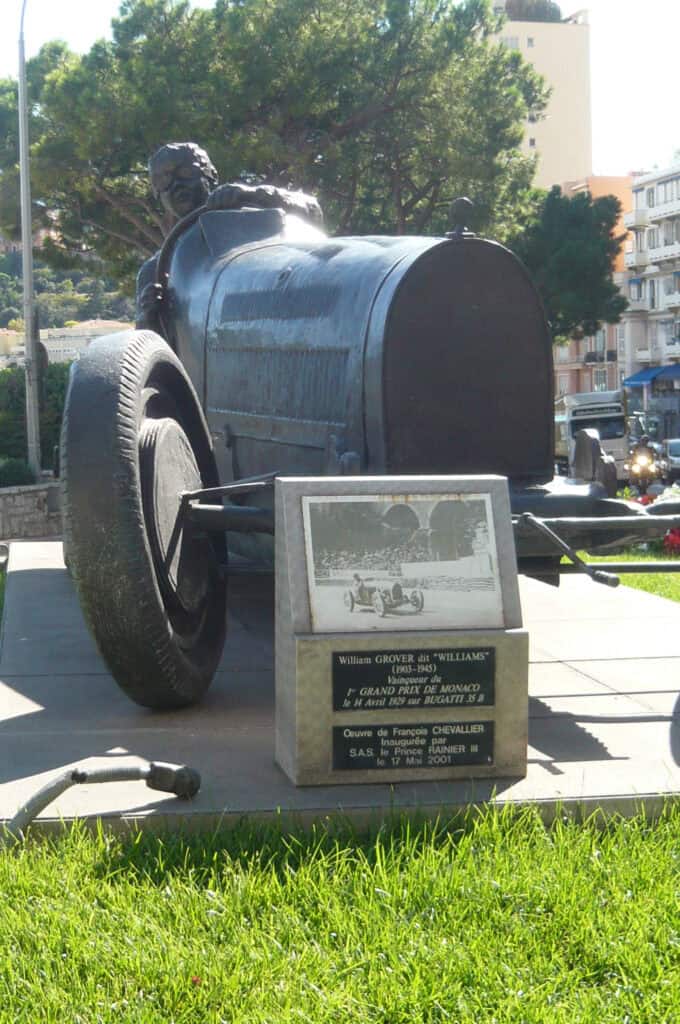
Willy Grover was recommended by Major General Colin Gubbins head of SOE for an MBE in September 1945. However one stipulation with this award it could not be made posthumously so no recognition was made. Yet a grateful France awarded him Croix de Guerre (Cross of War) a military decoration. The medal was created in 1915 and consists of a Malta type square-cross on two crossed swords in bronze crested by a Phrygian Cap with laurel leaves. Around the head are the words Republique Francaise. On the reverse are the dates of the conflict. It was designed by Paul-Albert Bartholome. It is a rough equivalent to the UK Military Cross and Military Medal. Yet perhaps the most fitting memorial to Willy is the life size statue of his Monaco Grand Prix winning Bugatti Type 35, with him at the wheel situated at the first corner of the circuit (Sainte-Devote Chapel). The statue is moved every year just a few metres for the race.
Grover-Williams was rightly proud of his first Grand Prix win, and the impressive silver trophy he was awarded. In the 1960’s his widow Yvonne went to England and presented the cup to the Bugatti Owners Club. The Grover-Williams Trophy race is still run today for historic Bugattis.
Robert Ryan wrote an entertaining fictional account of the lives of William Grover-Williams and Robert Benoist. However his claim to finding a different end to Willy’s life is hotly disputed. In that the Commandant of Sachsenhausen in an attempt to avoid prosecution claimed Willy was moved to Berlin in January 1945. However in 1946 he changed his story confirming the official line that he was executed on 18 March 1945 at the camp.