Two of our good friends have recently returned from a trip to the USA, mainly the Southern States. It got me thinking nostalgically of all our trips to the great republic which did we enjoy most.
Our last trip in 2018 was memorable for the cruise on the Mississippi from Memphis to New Orleans aboard the American Queen. San Francisco we loved during two trips to the west. Yet we both had no hesitation picking our trip to Virginia in 1999 as the best.
Looking at my diary of the trip we arrived at Dulles airport south of Washington on 8 September and picked up our hire car a Pontiac. We had seen the sights of Washington on an earlier trip thus we took Interstate 7 north-west to Leesburg and the first hotel a Great Western there about a twenty mile drive.
The diary entry reads: ‘Had a meal at Shenanigins; “Good food, good music, good times.” Drank beer from a bottle, noisy place food plentiful but not particularly good.’
After a good rest and sleep set off north into Maryland and then on to Pennsylvania weather overcast. On the campaign trail reached Gettysburg in about two hours. Did a tape tour in the car of the battlefield Margaret driving. Weather cleared in the afternoon headed south to Hagerstown. Refuelled 5.7 US gallons $7 having covered 140 miles, stayed in a Comfort Inn $74 very new and clean. That night heavy rain thunder and lightning just got a few things from a local supermarket to avoid the weather.
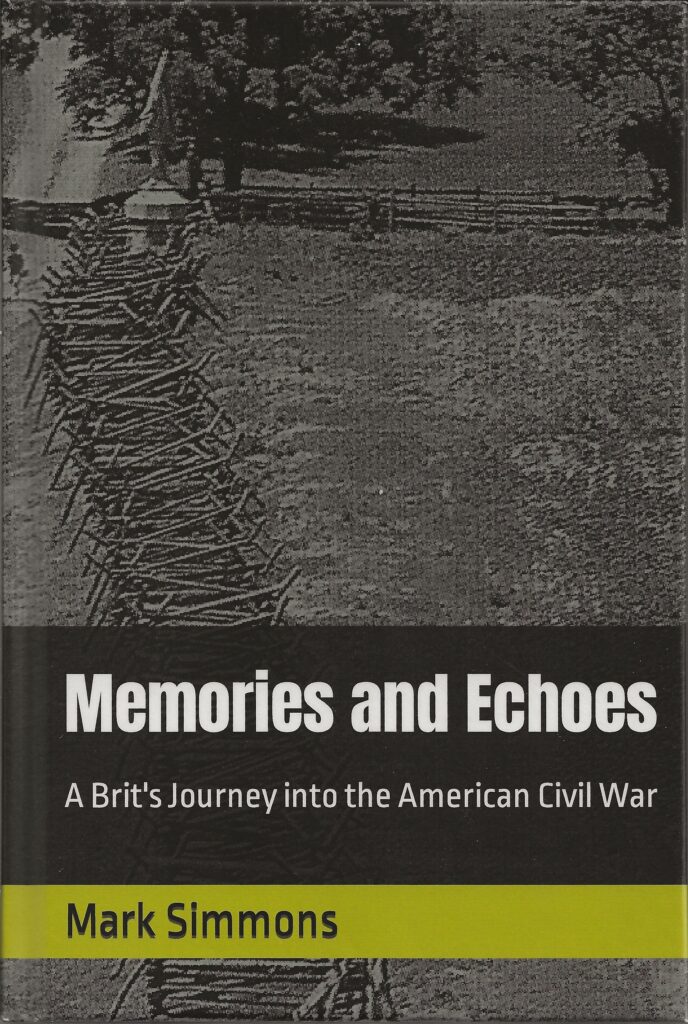
Next morning dull again but dry headed south toward the Antietam National Military Park weather soon improved to clear blue skies. Antietam battlefield is one of the best persevered. I cover our visit in my book Memories and Echoes: A Brit’s journey into the American Civil War here is a short extract.
‘Colin Fox was our car tape guide to the Antietam battlefield, as it was called by the Union, after the Antietam creek that flows north-south across the ground. To the Confederates it was Sharpsburg after the little town that lies barely a mile to the southwest.
Antietam was not as crowded as Gettysburg, during our visit we encountered perhaps a few dozen people and the battlefield is not so peppered with monuments. Even the crops in the fields are the same variety as they were on 17 September 1862, seasons allowing
At stop number eight, called Sunken Road or Bloody Lane, where Daniel Harvey Hill’s Confederate Division, mainly men from Georgia, North Carolina and Alabama, held this natural defensive position for four hours of the fiercest fighting of the day, against the Federal Second Corps of General Edwin Sumner and its three divisions, men from New York, Pennsylvania and Massachusetts. When the Federals at last took the lane, 5,000 men lay dead or wounded in and around the position. Today, at the eastern end of the lane, is an observation tower, from its elevated position we could see the entire battlefield.
There were six elderly Americans on the observation platform when we reached the top, puffing a bit. I admired their fortitude in making it up several steep flights of steps. It was the biggest group of people we had seen all day. One of the men was describing the scene of the battle quite eloquently and colourfully, for his enraptured audience. I would have had to been deaf not to listen in as I took in the views.


“They were slaughtered here in their thousands, 25,000 dead by the time the sun set. More than we lost on D-Day. Worst day in our History.”
“Is that a fact?” said one of the women listeners.
‘I turned around, the speaker, Jim, had his small group under his spell. There is something endearing about this American trait of exaggeration, what Mark Twain might have called “telling tall tales.” Margaret read the look in my eye and distracted me from the small group by pointing out some distant feature. Of course she was right, saving me from putting my big foot in it, by contradicting Jim on the subject of casualties which might not have gone down well, coming from a limey.’
According to the official sources the Union Army lost 2,010 killed 9,416 wounded and 1,043 captured. Confederate returns were 1,567 killed and 10,292 wounded and perhaps 2,000 missing. Given that probably half the men wounded might have succumbed to their wounds within a day or two the actual figure of dead comes out around 12,000-13,000 bad enough.
‘Worth a voyage across the Atlantic…’ So wrote Thomas Jefferson of the setting of Harpers Ferry when he first saw it in 1783. It was here we would enter the Shenandoah Valley and here in 1859 John Brown tried to instigate a slave uprising by sizing the Federal arsenal to arm those who joined him. His action, albeit a small affair in reality, did more to unite the South on the road to secession and civil war than any other.
In the John Brown Museum, I stood before his 1856 photograph, his face shows a firm, and beardless chin and mouth of utter conviction, and the eyes shone with fanaticism and madness, there would be no humour in this man. A gaggle of older school children approached led by a woman in her fifties.
‘Here is a good picture of Mr Brown who inspired the war.’
By that remark I doubted she had a southern background.
‘Is this the guy they sing about?’ asked one of the children.
‘That’s right’ said the woman.
‘Don’t look very friendly to me’ observed a boy wearing a baseball cap the wrong way around.
The woman uttered a sort of ‘hurmph’ to the boy’s observation and then: ‘It’s not a good likeness. Now then let’s move along we have lots to see and don’t crowd these people.’
Not a good likeness, I thought, it’s a photograph what did she expect. History has painted him from a martyr to a terrorist and murderer. That great wordsmith Alistair Cooke of Letter from America fame thought him a ‘…near-lunatic with a hot eye and single purpose…’ I rather liked the boy’s comment: ‘Don’t look very friendly to me.’
From Harpers Ferry we headed south crossing the state line into Virginia. In Front Royal our bed and breakfast the 1905 Chester House hosts Bill and Ann Wilson on Chester Street. There had been a house there since 1848; the present house built by Charles Samuels.
That night we had an excellent trout dinner in the town’s German restaurant recommended by Ann within walking distance. Slept well the house was cool even without air conditioning.
Saturday 11 September: woke to a lovely day breakfasted with a Welch couple Old Bill, Ann’s husband served breakfast the chiming clocks reminded me of a bygone age.
Out in the valley a few miles drive and we arrived at the Naked Mountain vineyard, returning to Front Royal we explored the local book shops. Back at the Chester House we relaxed in the garden where Old Bill served us homemade lemonade. He told us he was a ‘dammed Yankee’ these days they don’t mind folks coming from the north for a visit. ‘But dammed Yankee’s are those that stay in the south no better than carpet baggers.’ Ann was a southerner born and bread.

The next day Old Bill served us Yorkshire pudding’s for breakfast, perhaps he thought we needed building up as we were going hiking, served with maypal syrup. At the table were a young couple from Washington. I take it for their benefit he explained: ‘This pudding is often served with meat and gravy’ really!
This is where are walk in the woods really began at that stage I had not read Bill Bryson’s account which came out in 1997, a book I greatly like I keep a reading list and I read it in 2002 although I might have listened to it on audio tape before then.
Up in the Shenandoah National Park from Hogback overlook at 3,385ft, you can see many of the bends of the meandering south fork of the Shenandoah River, which brought up the song surely one of the best ever penned.
Oh Shenandoah, I long to hear you
A way you rollin’ river
Oh Shenandoah, I long to hear you, away I’m
Bound away, ‘cross the wide Missouri.
The song became a famous and beloved sea shanty. Yet both the Shenandoah and Missouri rivers are hundreds of miles from the sea. It’s believed the song originated further west perhaps on the Missouri and flowed down the Mississippi to the oceans of the world. Indeed any sailor, in the days of sail, away for years at a time, might well dream of seeing the gentle rolling Shenandoah. The song was certainly sung around the campfires of the Civil War.
At the Little Stony Man parking area near marker point 39, we stopped. From there we walked up to Little Stony Man and its bigger brother, Stony Man, which is the second highest peak in the park, a round walk of about six miles. Inquisitive dear crossed our path as we climbed higher, but we saw none of the park’s black bear population. The rocks over which we clambered higher are some 800 million years old. The Stony Man outcrops the result of lava flows. A bit breathless, we reached the summit having passed a marker informing us that here was the highest point of the Appalachian Trail within the park.
Sitting on the summit you can look all the way west across the great valley to the George Washington National Forest and on even further to the Allegheny Mountains. And the mountains do have a blue ridge, darker than the sky they are reaching for. It was as if we were the only people on earth, as if we were Lewis and Clark, or other European explorers seeing the valley for the first time, ahead lay a land stretching two thousand miles.


After leaving the Chester House our next stop in the Valley would be at the Llewellyn Lodge in Lexington with John and Ellen Roberts on South Main Street. I still have their letter confirming our booking for 13 September for two nights and how they were looking forward to seeing us ‘…in the near future.’ That was when people used to write letters how civilised dated Monday, August 23, 1999.

Tuesday 14 September: Had a lovely breakfast cooked by John he called us: ‘Lazy old things’ as we were up last jokingly the words rolling off his tongue with his soft southern accent. Just across the road in the cemetery was buried Thomas Jonathan (Stonewall) Jackson. John had been born in the Jackson house just down the street and married in the Mary Johnston House at Warm Springs we would be heading that way tomorrow staying at the Belle Heath Bed and Breakfast at Waynesboro.
From Waynesboro via Rockfish gap we spent another sparkling day in the SNP, hiking the Doyles River Walk, it looked promising at around 2,870ft. It was about five miles and called moderate by the guide book. In Bill Bryson’s book after several pages of describing what is wrong with the park with the pollution and over use by tourists he says: ‘And yet here is the thing. Shenandoah National Park is lovely. It is possibly the most wonderful national park I have ever been in, and, considering the impossible and conflicting demands put on it, it extremely well run.’

Oh it all seems so vivid again as if it were yesterday. To read more you can always buy my book Memories and Echoes: A Brit’s Journey into the American Civil War, which covers all our journeys over thirty years to the Southern States. Also my thriller Roundabout uses the setting of the Shenandoah Valley in one section.